How To Manage Your Time In ACCA Exams: The Marks = Minutes Method
Most ACCA students who fail by a few marks don't fail for lack of knowledge. They fail because the clock ran out with questions still blank. You studied the standards, learned the formats and practised the calculations. Then on exam day you spent too long on Question 1, rushed Question 3 and never reached the last part of Question 4. Sound familiar?
The fix is a simple rule that every strong ACCA candidate uses: Marks = Minutes. This guide shows you how to work out your number, use it in the exam hall and practise it so it becomes automatic before the December exams.
Why time management decides your ACCA result
In ACCA, a blank answer scores zero, and the first marks on any question are the easiest to earn. That makes time your most valuable resource in the exam. Markers award marks point by point. The first few valid points on a question come quickly. The last few take much longer and are harder to get. So 10 minutes spent starting a new question will almost always earn more than an extra 10 minutes polishing one you have already answered well.
The students who pass consistently are not always the ones who know the most. They are the ones who attempt every question and collect the easy marks everywhere.
The Marks = Minutes formula
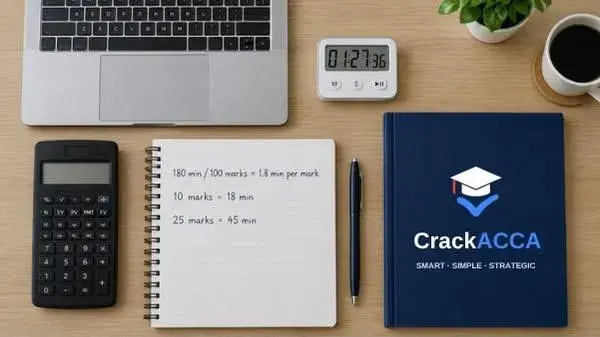
Divide your total exam time in minutes by the total marks. The answer is how many minutes each mark is worth.
{Minutes per mark} = {Exam time (minutes)}/{Total marks}}
For an Applied Skills paper such as FR, PM, AA or TX, the exam is 3 hours (180 minutes) for
100 marks: 180 \ 100 = 1.8{ minutes per mark}
Then multiply by the marks on each question to get its time budget.
Strategic Professional papers such as SBR and SBL run for 3 hours 15 minutes (195 minutes) for 100 marks, so each mark is worth 1.95 minutes. Applied Knowledge papers(BT, MA, FA) are 2-hour exams. Always check the exam time and total marks for your own paper on the ACCA website before you work out your number.
How to use it on exam day
Work out your time budget for every question before you start writing, then stick to it.
Write the finish time next to each question. Take a few minutes at the start to note the clock time you must finish each question by. In a computer-based exam, jot them on your scrap paper.
Plan before you write. Spend the first part of each question's budget reading the requirement and planning. A clear plan makes the writing faster.
Watch the clock, not the page. Check the time at the end of each requirement, not just each question.
When your time is up, move on. Leave a few lines of space, finish your sentence and start the next question. This is the hardest rule to follow and the most important.
Come back at the end. If you have time left once every question is attempted, return to the ones you cut short.
Answer the questions you are most confident about first if your paper allows it. Early easy marks build momentum and protect you from panic later.
The overrun trap
Overrunning on one question doesn't earn extra marks. It takes them away from your other questions.
Say you spend 40 minutes on a 10-mark question in a 3-hour paper. Its budget was 18 minutes, so you are 22 minutes over. Even a perfect answer can only score 10 marks, and you probably earned most of them in the first 18 minutes.
Those 22 minutes now have to come from somewhere else. That is enough time for a full 10-mark question plus a few more marks. Students who overrun early often end up rushing or skipping a whole question at the end, which can be the difference between 48% and a pass.
How to practise before exam day
Time management is a skill, so it only becomes automatic through timed practice.
Time every practice question. Set a timer to the question's budget, even when you are revising at home. Stop when it rings and mark what you wrote.
Notice where you overrun. Most students lose time in the same places, such as long written requirements or complex consolidations. Find yours and practise those under time pressure.
Sit at least two full mock exams. Do them in one sitting, at the same time of day as your real exam, using the computer-based exam format.
Review your mocks for time, not just marks. Check which questions you overran and how many marks you left on the table at the end.
Practise moving on. Deliberately stop mid-answer when the timer rings. It feels uncomfortable at first, which is exactly why you need to rehearse it.
Exam-day checklist
I know my paper's exam time and total marks
I have worked out my minutes per mark
I have written a finish time for every question
I will move on when a question's time is up
I will leave space and come back to unfinished answers at the end
Frequently asked questions
Does Marks = Minutes work for everyACCA paper? Yes. The rule works for any paper because it only needs the exam time and total marks. Just your number changes: about 1.8 minutes per mark for 3-hourApplied Skills papers and 1.95 for 3 hour 15 minute Strategic Professional papers.
What about reading and planning time? ACCA's computer-based exams don't have a separate reading period. Include your reading and planning inside each question's budget.
What if I finish a question early? Bank the time and keep going. You can use it at the end on the question you found hardest.
Is it ever worth going over time? Only by a minute or two to finish a sentence or a calculation line. Anything longer costs you easier marks elsewhere.
Start practising today
Marks = Minutes is simple to understand and hard to follow under pressure, so start using it now rather than on exam day.
CrackACCA gives you everything you need to practise it: lessons for everyACCA paper, practice question sets, full mock exams and live doubt-solving sessions when you get stuck. Sit a timed mock this week, see where you overrun and fix it before December.
Ready to crack ACCA the smart way? Sign up to CrackACCA and take your first mock today
Sources
ACCA SBL Syllabus and Study Guide: 3 hours 15 minutes, 100 marks
ACCA SBR Syllabus and Study Guide: 3 hours 15 minutes, 100 marks
ACCA 2026 exam format (PW): exam durations by level